
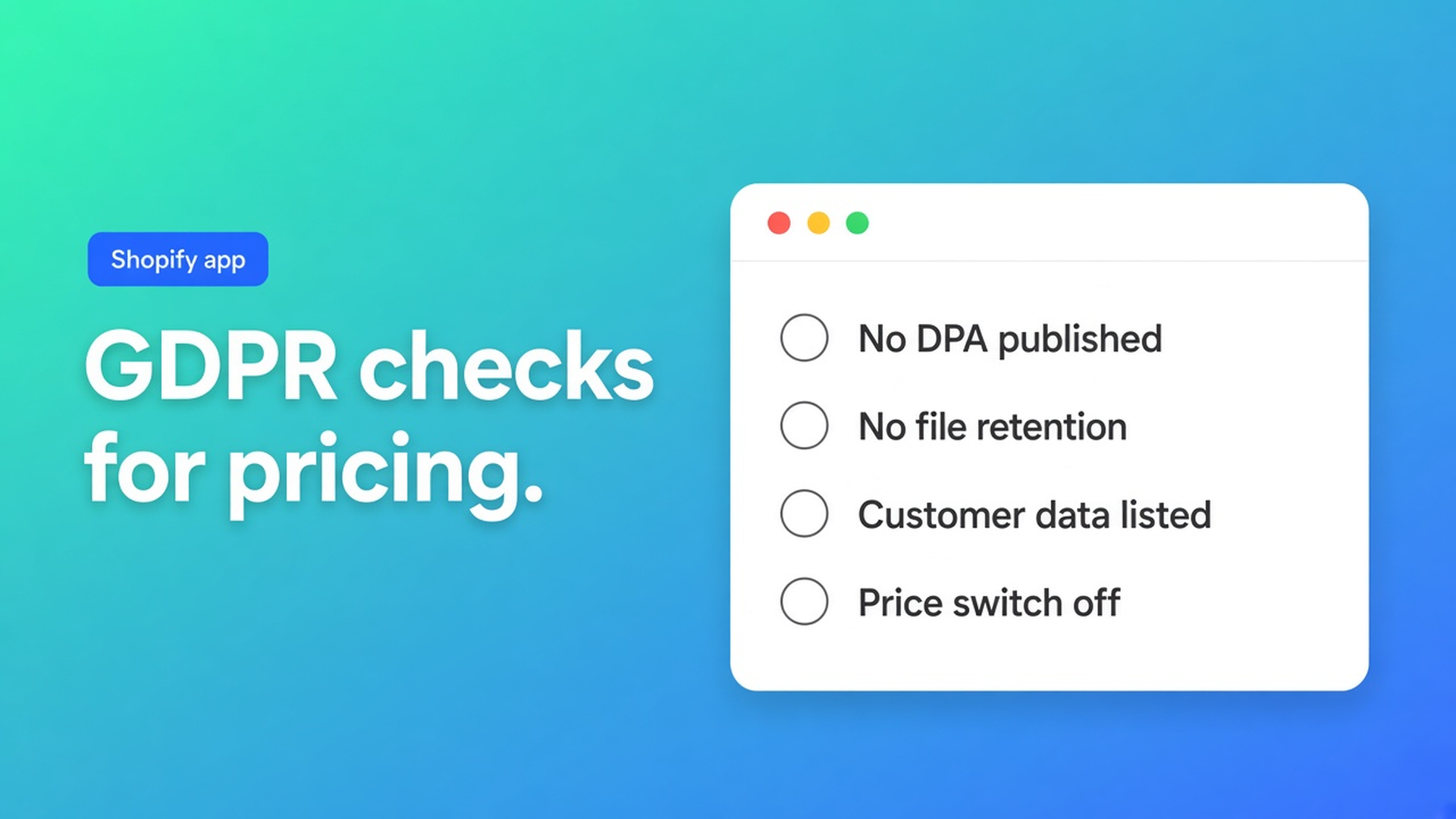
Which GDPR checks remove a Shopify price calculator from the shortlist?
A sign shop takes a customer’s artwork and adds a fee per file. Formulas come later. The first filter is what the app is allowed to see, and whether a processing agreement is actually published. On this check we opened the live listing of Options Price Calculator, the privacy policy that listing points at, the file-upload article, the order-confirmation guide, the server-side price switch, and Shopify Help *Adding variants*. Help tells you how to add variants, up to three options and 2,048 variants. It does not publish a DPA, a retention window for a design file, or a safety switch that starts in the off position. This note is that filter. It is not an install walkthrough, and it is not a rewrite of the policy.
Re-read the listing and the policy if a DPA appears, if the upload article names a retention window, if a data-access row disappears, or if the price switch defaults to on. The scopes below are from 8 November 2026.
Four hard nos, then one conditional yes
Drop the app before you score formulas when any of these is a real requirement and the source does not meet it.
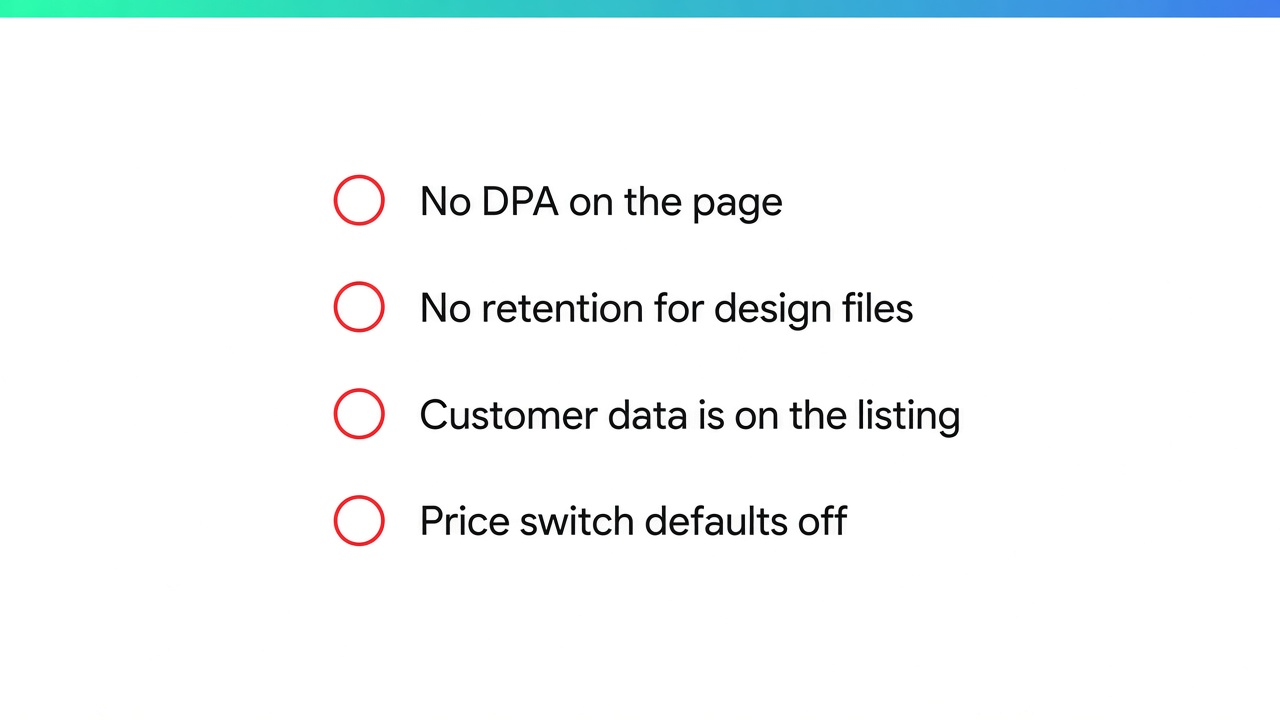
A signed processing agreement has to be on the public page, with no email required. It is not on the page today.
Design files need a published retention period in days. The upload article does not give one.
The app must not see the customer’s name, email, phone, or street address. The listing asks for those fields.
Every order must be price-checked on the server from the first install, with no extra save. The docs say the switch stays off until Theme settings are saved.
A fifth path is not an automatic pass. You accept that the policy keeps personal information inside Shopify, and you ask for the agreement at info@onlineorigins.nl. The app can stay on the list. The agreement is still an open item.
The data-access panel, read as a contract
Built for Shopify is on the listing. Rating 5.0 from 30 reviews, all fives. Launched 15 August 2025. Language: English. Works with Checkout. The three cards on screen match 7 November: 30 October, Orange Shapes; 29 October, Brooklyn Butcher Blocks; 23 October, Kingdom Decals. Review 30 is in the total. Its text was not on this screen. Prices are unchanged: Free with a 20-use cap, Starter $9.99, Premium $19.99, top card $39.99. This morning’s HTML includes an App Documentation row under Resources, plus the privacy policy. Yesterday’s fetch did not surface that docs row. An older note that says “no docs link” is stale for this check.
Access on the panel | What the listing names | Fails if your rule is |
|---|---|---|
Customer, sensitive | Name, email, phone, physical address | No customer PII |
Device | Geolocation, IP, browser, operating system | No device data |
Store owner | Name, email, phone, address | Staff identity stays out of the app |
Orders | All order history for the last 60 days, and draft orders | No order access |
Shopify Functions | Cart transforms, cart and checkout validations | No checkout function |
Admin files | Edit Files | No file write scope |
Other | View theme, locales, Markets | — |
That grid is the knockout. It is not a feature boast. A block that only reads the product page could ask for less. This listing asks for the set above because the calculated price reaches the order through a cart transform. The panel does not prove each field is read on every page view. It also is not a DPA.
The product page on this site, Options Price Calculator, is a way back to the listing. The scopes stay on the App Store.
What the policy page actually promises
The privacy policy is one general page for Online Origins apps. We read it on the same morning. It names the Billing API for Shopify subscriptions, and name, email, and store details when you contact support. It says the app does not collect other data independently of Shopify. Log files (IP, browser, ISP, referring pages, timestamps) last only while a technical issue is open, then they are deleted. Personal information is not shared with third parties except when the law requires it, and it is not stored outside Shopify. Contact is info@onlineorigins.nl, phone 073 234 0612, Bruistensingel 500, ’s-Hertogenbosch. A line at the top says the apps’ terms apply.
There is no processing agreement on that page. There is no day-count for an uploaded design. The 60-day order window from the listing is not repeated. Citing “the policy covers GDPR” cites a page that does not contain those three sentences.
Uploads, the email template, and the price switch
File Upload, last updated about six months ago on the article, describes the field. The shopper sends one to five files. You can allow images (JPG, PNG, WebP, GIF, SVG), documents (PDF, DOCX, XLSX, PPTX), video, and audio. The article’s size example is 50 MB total. The field can be required. A numeric value in the formula is multiplied by the file count: 15 with two files contributes 30; no file contributes 0. The listing puts “Lookup tables & file uploads” on the $19.99 card, not on Starter. The article itself does not name that plan. Only the listing prices the field.
The article does not name a bucket, a country, or a deletion window. The listing may edit Files in the admin. That sentence does not mean “the shopper’s artwork is written to Shopify Files and kept for thirty days.” Inventing it is the knockout.
The order confirmation is a different path. You back up the current template, open Shopify Settings, Notifications, Order confirmation, Edit code, and paste a prepared Liquid file. Then you place a test order. You are editing Shopify’s own notification. That is not an automatic export to a second system. The policy’s “no third-party sharing” line is neither proved nor disproved by a template you paste. It says nothing about how long a design file is kept.
The safety switch belongs here because the order line then carries `__ooCustomPrice`, and, when the switch is on, `__ooLiteSig`, `__ooPayloadHash`, and `__ooQuotedPrice`. Off is the default until you save Price settings. On, a bad signature means no expand. The switch is global. A storefront property cannot turn it off. That is price integrity, not a GDPR document. A requirement of “protected from the first order, with no extra click” fails until someone presses Save.
Stay on variants when the price does not move
Adding variants, read 8 November 2026, still caps a product at 2,048 variants and three options. Above that, Help points at an app or at line item properties in the theme. Properties collect an extra request. They do not change the unit price. The “100 variants” note is a warning about some themes and apps, not the ceiling. A tee in size and color stays a variant. You do not hand that product an app that can see 60 days of orders and a file field.
Use variants when the buyer picks from a fixed list, you track stock per combination, and you stay inside three options and 2,048 combinations. A PDF that adds a fee per file is not a variant. It belongs in a formula on Premium, or you accept that the price will not follow the file.
How the badge relates to the theme block and uninstall is the 6 November note. The variant ceiling as a filter is the 1 November checklist. Which URL may carry a sentence is the 7 November source note. A weighted comparison on other criteria is the scorecard. This page does not replace those four. It only says when privacy removes the install.
Shopify apps as a service, separate from this listing, are under apps and integrations.
Primary sources
Listing: Options Price Calculator, including data access and the $19.99 card.
Privacy policy. One general page. No processing agreement.
Where this lands today
On 8 November 2026, Options Price Calculator leaves the shortlist if you require a published DPA, a retention window for design files, no customer data in the scopes, or a price switch that is already on at install. If the rule is “data stays in Shopify, and I will ask for the agreement,” the listing is not an automatic no, and the agreement is still missing from the page. Check both URLs again the day any of those four sentences appears or disappears.
This blog is presented to you by

Floris-jan de Vries
Co-owner / Back-end developer / Shopify Expert
As a full-stack developer, Floris-Jan ensures the technical logic behind the design. He also uses his extensive knowledge of Shopify every day to provide our clients with the best possible support.


The Shopify Select partner for ambitious e-commerce businesses that want to grow!

Services
Reviews
5/5
Mail: info@onlineorigins.nl
Tel: 073 234 0612
KVK: 89825624
BTW: NL865123639B01
Bruistensingel 500,5232 AH 's-Hertogenbosch Cookies
© 2026 Online Origins