
When should Shopify shipping charge by dimensional weight?
A carton of cushions weighs little and fills a van. The scale says three kilos. The carrier prices the space. The useful question is when you want that space as your own checkout rate, and when a flat fee or the scale weight is enough. On this check we opened the live listing of OO ‑ Shipping Rates & Rules, the articles on product dimensions, units and the divisor, rate pricing, the plan requirements, and Shopify Help on shipping rates and carrier-calculated shipping. Help describes flat rates and rates from your own UPS, FedEx, or similar account. It does not describe a divisor you set in an app, or variant metafields named `$app.length`, `$app.width`, and `$app.height`. This note is that gap. It is not a zone setup guide.
Read it again if the app docs start treating Grow annual billing as enough, if 5000 stops being the “commonly” example, or if dimensional weight leaves the listing hero. The plan sentence below is from this morning.
What has to be true before checkout shows a space price
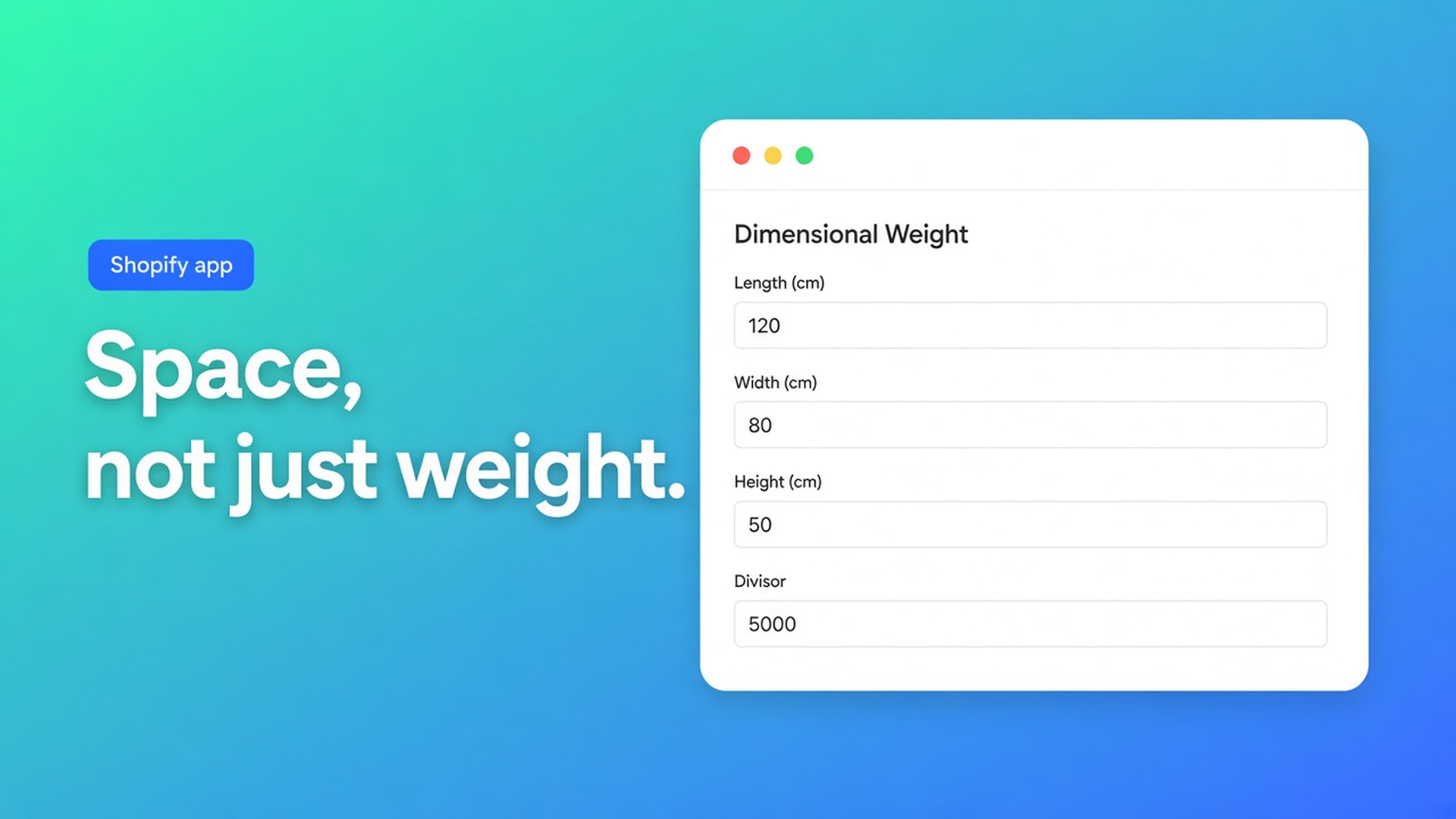
Dimensional weight is the right base when the carton costs more than the scale, and you want to build that price yourself.
Length, width, and height live on the variant. The app stores them as variant metafields `$app.length`, `$app.width`, and `$app.height`.
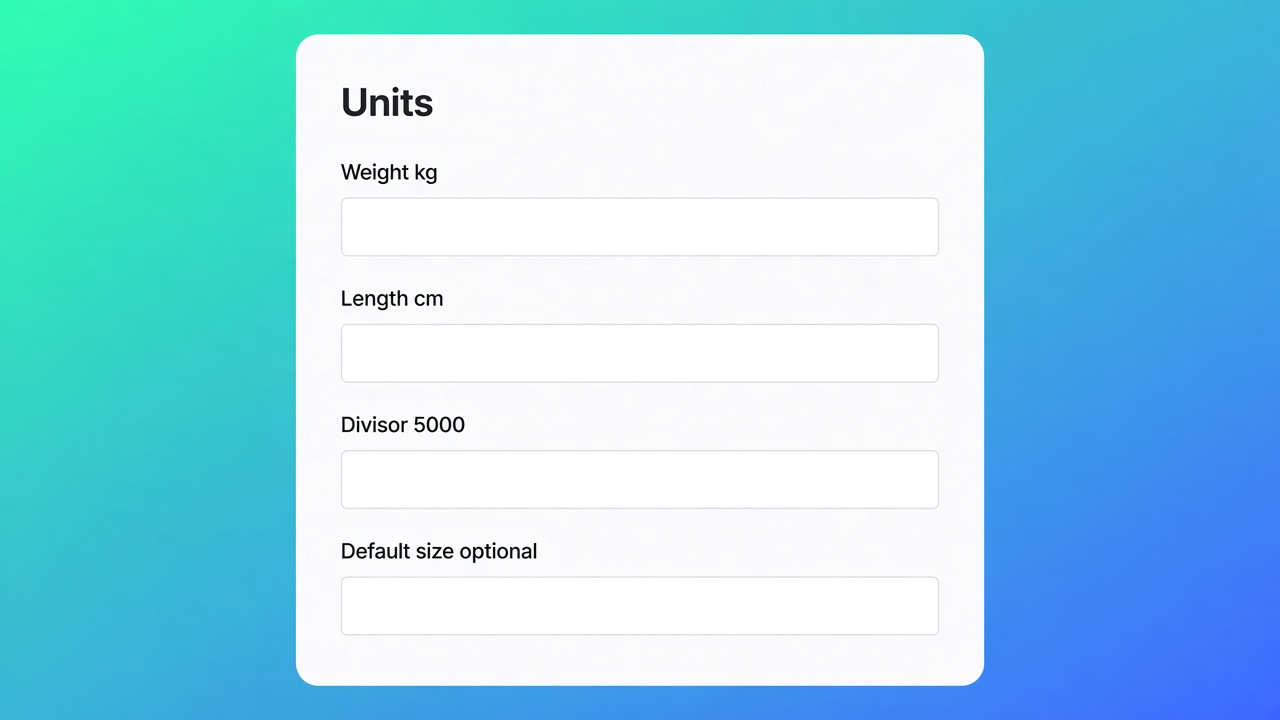
Settings, Units holds the weight unit, the length unit, and a dimensional-weight divisor. The docs call 5000 common for centimetres and kilograms. That is an example, not a statute.
The rate uses Cart dimensional weight, not only Cart weight.
The shop is allowed to return its own carrier price: Advanced or higher, a development or Partner development store, Plus, or a shop where that carrier is already active. Annual Grow billing is not listed as an exception in the plan article.
A missing size falls back to a default only if you set that default in Units. With no size and no default, volume and dimensional weight have nothing to multiply.
Hiding or renaming a method is a different job. It does not need Advanced. It also does not produce a space price.
Sizes, the divisor, and the line checkout receives
Product dimensions, last updated 16 days ago on the page: volume, girth, and dimensional weight need sizes. You fill them in the app under Product Dimensions, per product or variant. Missing sizes can fall back to the default from Settings, Units, when that default exists.
Measurement units and dimensional weight: weight unit (kg is the example), length unit (cm is the example), the divisor (commonly 5000 for a cm/kg style formula), and optional default dimensions. Those settings feed the cart and product numbers used in conditions and in the price.
Rate pricing options lists six bases: fixed, cart total, cart weight, cart quantity, cart volume, and cart dimensional weight. Volume needs sizes. Dimensional weight needs sizes and the divisor. A percentage or a threshold discount can follow cart amount, weight, or quantity, depending on what the editor shows. Checkout receives a service name, an optional description, and a price. Dynamic names from the flow are allowed. The carrier keeps service discovery off, so Shopify does not lock you to a fixed list of method names.
Question | A profile with a flat or weight rate | This app, cart dimensional weight |
|---|---|---|
Price follows the scale | Yes, if you set a weight rate | Cart weight is a different base |
Price follows the space | Not as a formula with your divisor | Yes, with L/W/H and a divisor |
Where the sizes live | Package or product weight in Shopify | The app’s variant metafields |
Empty size | No app default | Optional default in Units |
Your own price at checkout | A flat rate, or a carrier account | Only if the plan allows the carrier |
The listing hero names dimensional weight in the same breath as postcode, products, customer tags, and date. That is the condition range. The price base stays in the rate article. A “Dimension-based” chip is not a second divisor.
The plan, and what Help says next to it
Listing on 8 November 2026: Free, 0 reviews, launched 28 October 2026, language English, works with Checkout. No Built for Shopify badge in the header. The phrase “Built for Shopify” appears later on the page, on other apps, not as this listing’s badge. Inventing stars at zero reviews would be false. Resources link the privacy policy, a FAQ, and App Documentation. The app page on this site is OO Shipping Rates.
Shopify plan requirements, also updated 16 days ago and read today: a custom price through the OO - Shipping Rate & Rules carrier service typically needs Advanced Shopify or higher, a development or Partner development store, or Plus. If the carrier is already active, the app treats the shop as eligible even when the plan name looks lower. Hide, rename, and reorder work on more plans. A blocked shop sees a plan banner and a checklist aimed at delivery customization, not at its own rate.
Third-party carrier-calculated shipping, read 8 November 2026, is about your own account with UPS, FedEx, USPS, Canada Post, or Australia Post. Advanced and Plus include that connection. Grow can add CCS for an extra monthly fee, or by switching to annual billing. The fee amount is not on this Help page, so no currency figure is quoted here. That Help sentence is not a pass for this app’s own carrier rate. The plan article does not list Grow annual billing as an exception. A Grow shop on Help’s yearly contract is not automatically “carrier already active.” That status is a fact in the shop, not a guess from the billing period.
Shipping rates, same morning: flat rates you set, free shipping, or carrier-calculated rates where the carrier sets the price. Profiles and zones remain the native layout. The page says shipping is gradually moving to shipping options by market, and that existing rates migrate. There is no divisor and no app metafield.
When the scale is enough
Stay with a weight rate or a flat fee in the profile when every carton costs about what it weighs, you do not need a postcode exception, and you do not want your own formula. Help’s carrier account is enough when you want UPS or FedEx to price the label, including their packing, and your plan includes that connection. The app starts when the price is a divisor you chose, sizes differ by variant, and checkout should show one line you named.
Seven-day logs and hiding a method do not belong in this answer. They are in the logs note and in the 7 November hide checklist. The carrier gate itself is spelled out in the 1 November checklist. Profiles versus a carrier app are the 4 November note.
Shopify apps as a service: apps and integrations. The privacy policy is the general page, with no separate processing agreement.
Primary sources
Where this lands today
On 8 November 2026 you charge by dimensional weight when the carton costs more than the scale, the variant has length, width, and height, and you set a divisor (commonly 5000 for cm/kg, not a law). Checkout shows that price only when the plan allows the carrier: Advanced, a development store, Plus, or a carrier that is already active. Grow on yearly billing is not an automatic yes. OO ‑ Shipping Rates & Rules is Free there, with zero reviews. Re-read the plan article if Grow becomes an exception, or if Help prints the fee amount.
This blog is presented to you by

Floris-jan de Vries
Co-owner / Back-end developer / Shopify Expert
As a full-stack developer, Floris-Jan ensures the technical logic behind the design. He also uses his extensive knowledge of Shopify every day to provide our clients with the best possible support.


The Shopify Select partner for ambitious e-commerce businesses that want to grow!

Services
Reviews
5/5
Mail: info@onlineorigins.nl
Tel: 073 234 0612
KVK: 89825624
BTW: NL865123639B01
Bruistensingel 500,5232 AH 's-Hertogenbosch Cookies
© 2026 Online Origins