
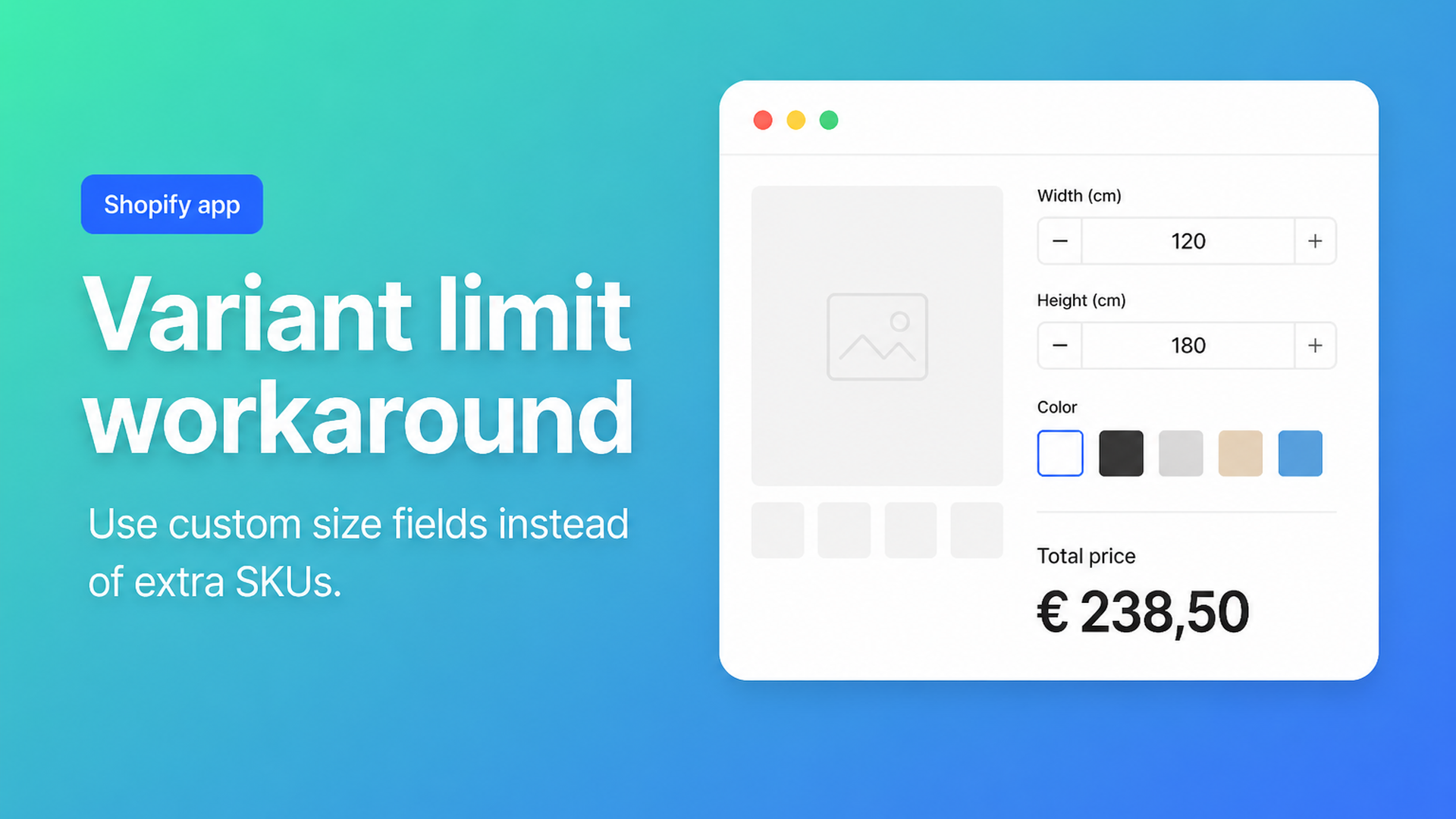
Shopify variant limit workaround: 2048 SKUs still are not custom options
A Shopify variant limit workaround is still the first thing merchants search for when a made-to-order catalog will not fit the admin. In October 2025 Shopify raised the ceiling from 100 to 2048 variants per product. That looks like a complete fix. It is not. You still get only three options per product. You still cannot turn every millimetre into a SKU. Theme inputs still do not change the price.
If you sell print, cut-to-length metal, blinds, or anything priced from a formula, the useful question is not “how do I squeeze in more variant rows”. It is which choices need inventory, and which belong in fields on the product page. Options Price Calculator is built for the second group: unlimited options and live formula pricing, without a new variant for every size cell.
This article states the current limits, why the usual workarounds stall, and how to keep a clean catalog.
What the variant limit actually is in 2026
Shopify Help Adding variants is the source of truth:
up to 2048 variants per product;
up to three options per product (Size, Color, Style — or any three names you pick).
The cap moved to 2048 for every merchant on 15 October 2025 (Shopify changelog). The three-option rule did not. Merchants in 2k variants now generally available said it first: “still only 3 options max.” Extra SKUs help apparel brands with large size × colour grids. They do not give you a fourth axis, free text, a file upload, or price = width × height.
Other ceilings still apply:
250 media items per product, and a variant image must come from that list;
some themes, theme app extensions, and sales channels still struggle above 100 variants;
Liquid returns at most 250 variants unless you paginate — a 1,500-row dropdown is not a storefront strategy.
So the old “100 variants” claim is outdated. Treating 2048 as a Shopify variant limit workaround for custom work is the new mistake.
Workarounds shops try first
Blow the price grid into variants
A banner printer thinks in a matrix: 16 widths × 16 heights × 5 materials. That is 1,280 variants — under 2048 until you add a hem or a coating. Inventory per cell is fiction (you print to order). The admin slows down. The customer faces a spreadsheet inside a select. You “worked around” the limit by filling it.
Split one product into many
One model becomes five listings so each page gets three options again. That is legal. You also get duplicate URLs, messy related products, and a shopper bouncing between pages for the “same” blind in another fabric. Combined listings can tidy the grid. They do not calculate a live area price.
Line item properties in the theme
Liquid can add `<input name="properties[Width]">`. Shopify stores the string on the line item. Production can read it. The price does not move. Pricing is attached to variants, not to properties. Threads such as How to increase price when someone choose custom option and How to add price to the variants thats over the variant limit stall on exactly that: extra fields without an app or a Function are labels, not a till.
Metafields dressed up as options
Same trap. Metafields reuse content. They are not a price engine. Without a real variant or a cart transform, checkout stays on the base price.
None of this is wrong for genuine SKUs. It is the wrong tool for continuous sizes, surcharges, or a fourth choice. We already covered the three-option ceiling; this piece is about the variant cap as a false workaround.
The workaround that holds: options beside variants
Keep native variants for stocked combinations. A colour you actually warehouse, or a base material with its own SKU, should stay a variant. Anything that does not need its own inventory row — free size, extra finish, file, text, setup fee — belongs in product options with a formula.
Options Price Calculator is that split: unlimited fields (dropdowns, swatches, numbers, checkboxes, file upload, text) on the product page, a formula that updates the price in real time, and no extra variant per choice. It is Built for Shopify, installs as a theme app extension, and still lets you attach a different calculator to each real variant (wood vs. metal, for example).
A typical formula from the docs:
``` product_price + (width * height) ```
Or with a fixed setup charge:
``` product_price + 25 + (width * height) ```
The customer sees the total change as they type. The order carries the entered values. Server-side price validation (an app-wide setting) means the calculated price is checked, not only painted in the browser.
Label Premium as Premium: conditional logic (if/then, a higher rate above a threshold, a minimum price), live preview / Product Personalizer, the font picker, and a real-time price breakdown. Starter already covers unlimited options, the formula builder, metafields, AI-generated fields, and multilingual labels.
Example: cut-to-length metal without 2,048 saw cuts
Take an aluminium U-channel. Customers order any length between 200 and 3,000 mm, pick anodised or mill finish, and optionally ask you to cut the bar in two.
Native variants cannot model this. Every millimetre × two finishes already blows past 2048, and you have spent your three options. Line item properties capture the length and leave the metre price untouched. Email quotes do not scale.
In Options Price Calculator:
Keep alloy or profile type as a real Shopify variant (own SKU, own stock).
Add a number field `length_mm` with min/max.
Use a dropdown or checkbox for anodising with a numeric value (surcharge or multiplier).
Add a checkbox for a cutting fee.
Use a formula such as:
``` product_price + (length_mm * price_per_mm) + anodize + cutting ```
`price_per_mm` can be a field value, or a product metafield when each profile has a different rate but you want one calculator. One product, a short variant list, a price that scales with length.
The same pattern covers fabric by the metre, banners by the square metre, and made-to-measure: continuous input plus a formula, not a variant per cell.
Need a higher rate above 2,000 mm, or a floor so tiny cuts do not go out below cost? That is Premium conditional pricing, not Free or Starter.
What you need to start
Install Options Price Calculator. Free plan: 20 uses (always free on a Shopify Develop store). Starter is $9.99/mo for unlimited options; Premium is $14.99/mo for conditional logic and live preview.
Add the app block to your product template — How to Add the Extension to the Product Page. Recommended placement: below the price, above Add to cart.
Build fields for everything that is not a SKU. Keep real stock as variants.
Write the formula, test with preview values, round at the end (`Math.round`, `Math.ceil`).
Link the calculator to the right variants, in bulk if the catalog is large.
Recheck theme bindings (price and ATC selectors) if the theme is custom; rerun the selector picker after a theme switch.
Then you have one product page, a live total, checkout at the right price, and fulfillment looking at the same measurements as the customer.
Wrap-up
A Shopify variant limit workaround is not “keep adding SKUs until 2048”. The 2048 cap helps when combinations are real inventory. Custom work — a fourth choice, a typed length, a surcharge, an upload — belongs beside variants, in fields with a formula.
Put that calculator on the product page with Options Price Calculator and let customers configure instead of waiting for a quote or opening a thousand-row dropdown.

Custom webshops, websites, and applications combined with smart online marketing to help your business grow online!


Reviews
5/5
Mail: info@onlineorigins.nl
Tel: 073 234 0612
KVK: 89825624
BTW: NL865123639B01
Bruistensingel 500,5232 AH 's-Hertogenbosch Cookies
© 2026 Online Origins