
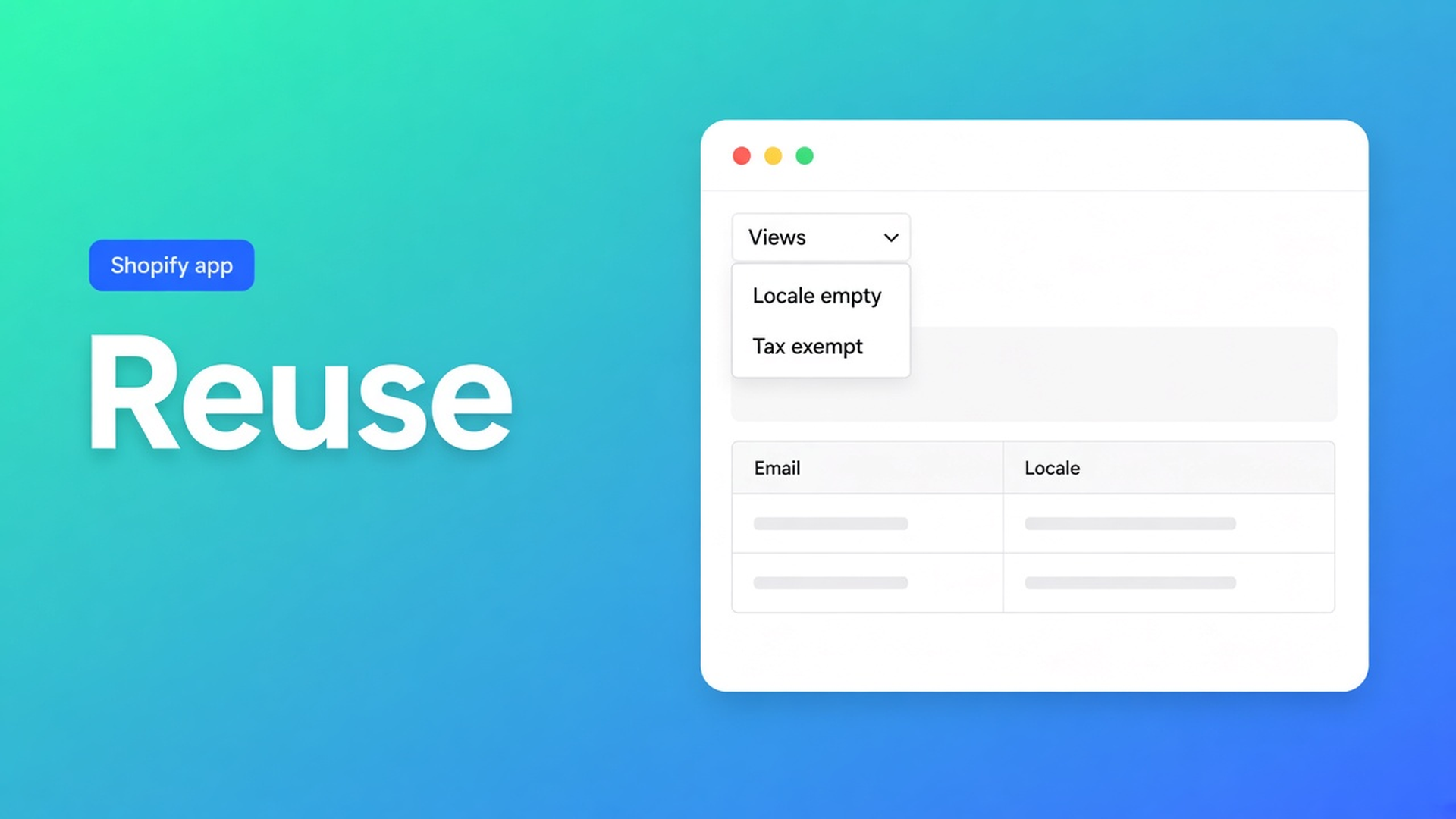
Save and reuse Shopify customer views for repeating cleanup jobs
The migration was three months ago. Locale is still empty on a few hundred leftover accounts. Every Friday someone rebuilds the same column set, forgets `is empty`, and Select all matching (up to 50,000) stages the wrong people. Shopify save and reuse customer views is the repeatable job, not the first Save as new click.
How Save as new / Apply / Update current works is already in saved customer views. Filters are the query layer. This piece is the cadence: open the named job, run it, leave. Listing for OO - Bulk Customer Data Editor: *save reusable views*. Docs: Save and reuse views.
Repeating work needs a name, not a screenshot
Shopify’s native Customers list has no “Friday locale sweep” view. A customer segment is a living group, not a column layout. The Columns picker remembers the layout in this browser (columns, filters, and sorting). New machine, new intern: defaults.
A view stores columns, filters, sort, and an optional segment for the whole shop. Apply is the start of the job. Then bulk apply: Field → Value → Apply to selected → Save. Changes stay staged until Save. Select-all matching follows the *current* search, segment and filters — the view you just applied.
Hero fields stay Customer Locale and tax-exemption status, the ones Shopify’s standard editor makes painful in bulk. Reusable views are how those two jobs stop being redesigned every Friday.
What teams do until the ritual collapses
Rebuild filters from memory. Fine at 80 rows. At 2,000 leftovers, `is empty` disappears and the bulk apply hits everyone.
A checklist in Slack. Three people, three grids. Locale filter set to `is` instead of `is empty`.
A new Shopify segment every run. Segments are useful and shop-wide. They do not choose columns. A view *may* include a segment; it does not replace one. Create a segment from filters is a different path.
None of those: Apply `Locale empty` → select-all matching → bulk apply English (`en`) or Dutch (`nl`) → Save, keep the tab open.
Apply first, edit second
OO - Bulk Customer Data Editor is Free. Listing 0.0 (0 reviews). English UI. Excel and Google Sheets via CSV. Open from the dashboard or Customers → More actions → Edit in bulk. Views are shop-wide and listed on the dashboard — that is the launch pad for the ritual, not a private browser layout. Click the named view, land in the editor already filtered. Skip Apply (or skip that jump) and you are back to an empty grid and a select-all that can cover the whole list.
A Friday sweep
Open the editor. Views → Apply today’s job. Do not rebuild Columns/Filters unless the source data changed.
Confirm the grid: a locale job shows locale, not tax exempt in front.
Select-all matching (cap 50,000). Bulk apply the value. Review staged rows. Save. Keep the tab open on large batches.
Stop. Use Update current only when the *job* itself shifted (an extra filter), not because you peeked at another field.
Two jobs, two names. `Locale empty` is not `Wholesale tax exempt`. Mix them in one view and you reuse the mistake. Identity columns stay visible. Read-only columns (total spent, order count, created date) can stay for sorting.
FAQ: large shops search or segment first, then filter. Empty CSV cells do not clear values on update. Views do not change those limits; they stop you reusing the wrong filters.
Staff need `read_customers` and `write_customers`. “Customer access is blocked” is Shopify refusing the app’s Customer API — not a bulk lock on accounts. See the earlier article if that banner appears.
Example: leftover migration locales, monthly wholesale audit
A replatform left 600 guests on the store-default locale. Wholesale tags exist on 90 B2B accounts; tax exempt is still off. Locale is a weekly leftover sweep. Tax exempt is a monthly audit.
Friday:
Apply `Locale empty` (locale column on, is empty, address columns off). If the view does not exist yet, create it once — saved views covers Save as new.
Select-all matching. Bulk apply the locale you actually send mail in. Two markets? Two views (`Locale empty EN` / `Locale empty NL`).
Save. Tab open.
First Monday of the month, different browser:
Apply `Wholesale tax exempt`. Do not “tweak” the locale view.
Bulk apply tax exempt. No untagged guests in the selection if the filter is right.
Save.
Tuesday colleague: Apply `Locale empty`. Same columns, same filter. No thread asking how it was set up.
New metafield in the job? Apply the view, show the column, Update current. Do not overwrite the other job by accident.
Start the cadence
Install OO - Bulk Customer Data Editor (Free).
First run: set one job, Save as new, a name the team will say out loud.
Next run: Apply only. Then bulk apply. Select-all matching up to 50,000.
Test Apply in another browser. Shop-wide, not “my Chrome”.
No other OO app in this post.
Close
Shopify save and reuse customer views is the weekly Apply, not the one-off Save. The picker lives in a browser. The view lives on the shop. Native Customers has no named jobs.
Keep `Locale empty` in OO - Bulk Customer Data Editor and let the next leftover sweep open the same grid — without reinventing the filters.

The Shopify Select partner for ambitious e-commerce businesses that want to grow!


Services
Reviews
5/5
Mail: info@onlineorigins.nl
Tel: 073 234 0612
KVK: 89825624
BTW: NL865123639B01
Bruistensingel 500,5232 AH 's-Hertogenbosch Cookies
© 2026 Online Origins